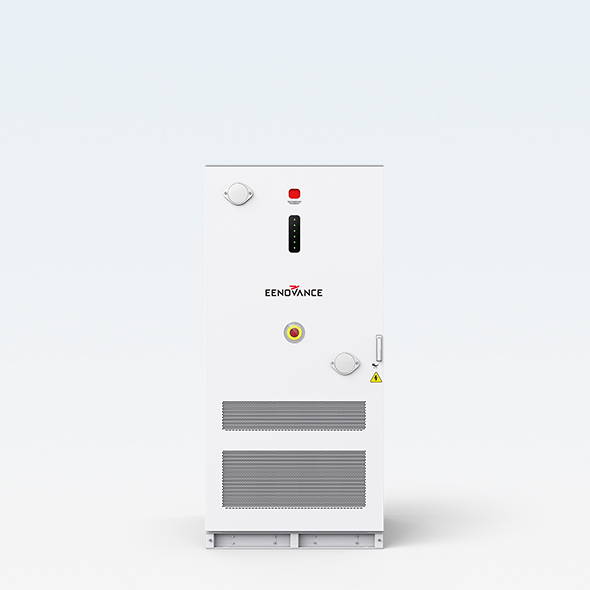


TED Ceramica Rooftop PV & Battery Storage Project, Bulgaria
- Location: Bulgaria
- Configuration: 14 * E-MATE 125-261-L
- Capacity: 3.66 MWh
- Application: PV+Storage
- Year: 2026




Project Overview
TED Ceramica makes ceramic tiles, sanitary ceramics and building materials in Bulgaria, with production sites in Plovdiv, Kardzhali and Parvomay. A rooftop photovoltaic installation already covers a substantial share of the factory's electricity, but that solar power is used only as it is produced, with no way to store it for later.
The requirement for the site was therefore storage at scale, alongside the existing rooftop photovoltaic installation, so the solar generation could be dispatched rather than simply consumed as it came. EENOVANCE's C&I ESS E-MATE 125-261-L is exactly what that requirement calls for.
The project was delivered with Elcom Stroy in Bulgaria, out of an established working relationship rather than a tender. TED Invest commissioned the installation for the TED Ceramica production site.

EENOVANCE Solution
Fourteen E-MATE 125-261-L systems are installed at the site, each an independently integrated cabinet, and together they operate as a single installation. Every cabinet combines a 125 kW power conversion system with a 261.25 kWh liquid-cooled LFP battery system, and the fourteen units run in parallel on the 400 V AC side with precise current sharing.
The cabinets are installed outdoors on a common foundation line, alongside the production hall. Liquid cooling and IP55 enclosure protection allow the systems to operate in place without a dedicated building.

1. Subsystems
- Thermal management: liquid cooling maintains uniform cell temperatures across the full battery system, supporting higher energy density and lower noise within a compact footprint.
- Energy management system: an intelligent EMS provides remote monitoring and fault diagnosis across the whole installation.
- Enclosure protection: IP55-rated outdoor cabinet, with IP67 protection on the battery packs themselves.
- Conversion efficiency: the integrated power conversion system reaches a peak efficiency of 98.5%.
2. Operating Modes
- PV integration: stored energy is charged from the site's own photovoltaic generation, made possible by the AC-coupled architecture.
- Peak shaving: stored energy is discharged to flatten demand peaks at the commercial site.
- Energy management: control over when stored energy is used.
3. Modular Scaling
The installation scales in fixed steps of one cabinet. Each unit adds 125 kW and 261.25 kWh, and the architecture of the installation stays the same.

Together, these capabilities turn the site's solar generation into a dispatchable asset. The factory flattens its demand peaks and makes fuller use of its own energy, and the system can grow with the site, without replacing the existing photovoltaic installation or building a dedicated facility.
Related Products